

Scaling complex commerce, explained


E-commerce was built for simple buyer journey products – not complex ones.
It works beautifully when every shopper follows the same simple rules – pick a product, add to cart, check out. But the world doesn’t run on simple products alone.
It also runs on the services that power modern life – like internet, insurance, utilities, and home security. Products that don’t fit neatly into a shopping cart.
The next trillion-dollar shift in commerce isn’t about selling the same straightforward offerings. It’s about unlocking a new world of sales never before prioritized.
That’s complex commerce. That’s what we do.
What is complex commerce?
Complex commerce refers to the process of selling products and services that involve expansive rules, logic, and dependencies.
These aren’t impulse buys. They require precision, timing, compliance, and often, human interaction.
Think of anything that can’t live inside a simple shopping cart:
- An internet plan that changes price and availability by address
- A home security system that requires installation on a specific date
- Insurance that requires eligibility and verification
- Utilities that vary by township or physical infrastructure
Traditional e-commerce wasn’t built to handle any of this.
Updater is building systems for everything that doesn’t fit squarely in a cart.
How we got here
Updater started with one of the most complicated consumer moments there is: moving.
When people move, they need to set up internet, insurance, security, and utilities – in a short period of time, across different systems that don’t talk to each other. It’s messy, disconnected, and full of friction.
So we built technology that could handle it – logic, compliance, timing, fulfillment – and we made those experiences feel simple.
Over time, we realized that moving wasn’t the only place this problem existed.
It was everywhere.
The DNA of a complex product
Complex products share the same DNA:
- Logic: They can’t be sold without knowing who the buyer is, where they are located, or what they’re eligible for.
- Compliance: Every transaction includes disclosures, regulations, or fine print that must be followed.
- Timing and trust: They’re often bought at key life moments – moving, marriages, job changes, refinancing, or other life transitions.
Each of these layers adds friction.
And friction kills conversion.
Why the old model doesn’t work
Traditional e-commerce is great for simple transactions. In complex commerce, every buyer is different. A one-size-fits-all checkout breaks the moment some small piece of logic or a regulation enters the picture.
The result is disconnected systems, poor experiences, and missed revenue – a web of partial integrations that leave customers frustrated, providers underperforming, and businesses unable to capture the full value of their demand.
What Updater does differently
Updater was built to fill the complex commerce gap. We’ve created specialized commerce platforms designed for complex transactions.
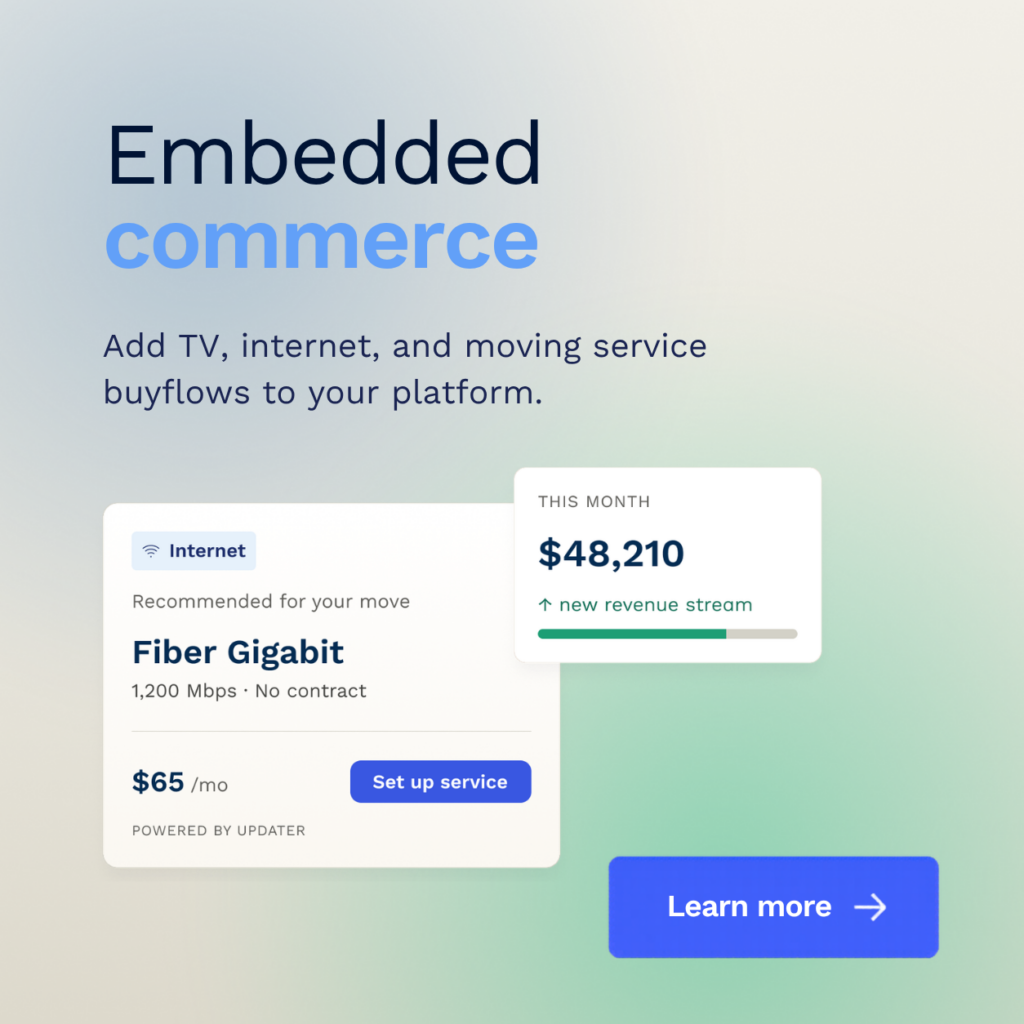
Today, we build portable buy flows – checkout experiences that can live inside any surface, from an app to a call center to an AI agent. They handle all the complex stuff, including logic, eligibility, and compliance.
We distribute those buy flows across a proprietary network of channels – apps, call centers, AI agents, and partner platforms – and route real orders placed on those channels directly to providers.
One integration. Endless distribution. Actual conversion.
Updater doesn’t drive clicks. We drives sales. Real orders.
Why it matters for the future of commerce
Commerce is changing fast. AI, embedded experiences, and voice interfaces are redefining where and how people buy. There are channels being built right now that were incomprehensible just 6 months ago.
As commerce evolves, consumer expectations are evolving faster. People will no longer tolerate friction when purchasing complex products – they’ll expect the same instant, effortless experience they get everywhere else.
The companies that meet that expectation will own the next era of growth.
Complex commerce isn’t a niche. iIt’s the backbone of modern life – a multi-trillion dollar category ready for transformation. And it deserves better infrastructure.