

What actually drives resident satisfaction during move-in


It’s not fewer tools. It’s fewer confusing moments.
Move-in day is rarely simple.
For residents, it’s a blur of instructions, emails, apps, and deadlines. For onsite teams, it’s a constant balancing act: answering questions, fixing issues, and keeping everything moving, often all at once.
When something goes wrong, residents don’t think about systems or software choices. They think:
“I don’t know what I’m supposed to do right now.”
That feeling, more than any single issue, is what shapes their experience.
Residents don’t expect zero effort. They expect clarity.
There’s a common assumption in property tech that the best experience is one where residents don’t have to engage with anything new. In reality, that’s not how people behave.
Residents are willing to:
- Download an app
- Create an account
- Follow a set of steps
As long as it’s clear why they’re doing it and what it helps them accomplish.
What frustrates residents isn’t effort. It’s effort that feels pointless.
That need for clarity shows up immediately, often in the very first message a resident receives from their new community.
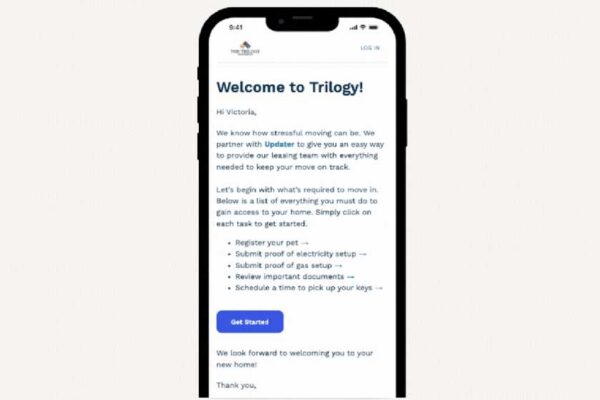
The welcome email is more than a formality. It’s the moment residents decide whether they feel oriented or overwhelmed. When that message clearly answers “where do I start?” and “what actually matters right now?”, everything that follows feels more manageable.
When it doesn’t, confusion tends to compound quickly.After sending millions of move-related emails, we’ve seen this pattern consistently: the earliest moments of communication set expectations for the entire move-in experience.
Where move-ins break down
When residents feel stressed or unhappy during move-in, it’s usually because:
- Instructions came from multiple places
- Messages contradicted each other
- They weren’t sure where to go for help
- Or they didn’t get answers when something went wrong
From the resident’s point of view, it feels scattered.
From the team’s point of view, it feels like juggling too many systems at once.
This is the gap technology is supposed to solve, but often doesn’t.
One clear place beats many half-clear ones
Move-ins tend to feel smoother when residents know one thing above all else:
“This is where I start.”
Not because teams want to add another tool, but because residents need a clear guide.
When there’s a single place that:
- Explains next steps
- Keeps required tasks organized
- Provides access to help when needed
Everything else feels more manageable, even if multiple systems still exist behind the scenes.
Clarity doesn’t come from eliminating tools. It comes from being intentional about which tools residents interact with and how.
Not all resident touchpoints are the same
There’s a big difference between:
- Being asked to sign up for something that adds confusion
- And being guided to a tool that actually reduces it
A good resident-facing tool earns its place by:
- Replacing long email threads
- Reducing back-and-forth questions
- Helping residents stay on track without guessing
- Giving onsite teams support when issues arise
When that happens, residents don’t see the tool as “one more thing.” They see it as the thing that helped them get through move-in.
Why this matters for onsite teams
Onsite teams don’t need fewer tools at any cost. They need:
- Fewer “Where do I send them?” moments
- Fewer repetitive questions
- Fewer fire drills caused by missed steps
The right tools reduce mental load by giving both residents and teams a shared source of truth.
When that tool is backed by real, responsive support, it becomes an extension of the team rather than another system to manage.
The takeaway
The goal of move-in technology isn’t to disappear.
It’s to guide.
Residents don’t need fewer steps. They need clearer ones.
Teams don’t need bigger platforms. They need tools that reduce confusion instead of redistributing it.
When move-ins feel understandable and supported, satisfaction follows, even when things don’t go perfectly.
And that’s what residents remember.
See what residents have to say about Updater
See what community teams have to say about Updater
More Industry Insights
What we’ve learned about writing resident welcome letter emails
25 March 2026

Telecom isn’t ecommerce – it’s infrastructure
17 March 2026