
What we’ve learned about writing resident welcome letter emails

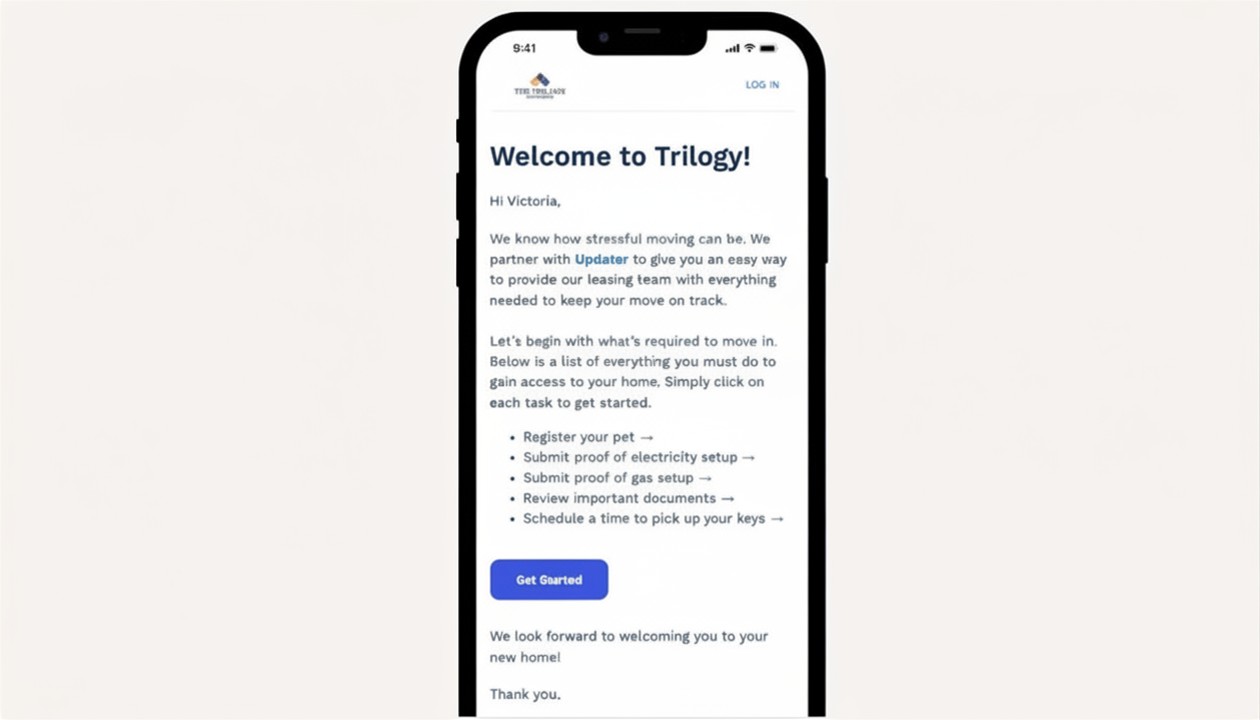
(After helping almost 12-million residents move and sending millions of welcome emails.)
Moving is stressful. Even in the best-case scenario, residents are juggling logistics, deadlines, and uncertainty all at once.
That’s why the first message a resident receives from their new community matters more than we sometimes realize. A good welcome email doesn’t just say “hello.” It sets expectations, builds confidence, and answers the quiet question every resident has:
“Am I on the right track?”
At Updater, resident emails are something we think about a lot. After sending millions of move-related messages on behalf of multifamily communities, we’ve learned a few things about what actually works and why.
Here are some of the principles that consistently make a difference.
1. Start with relevance and orientation
It’s tempting to lead a welcome email with a long introduction or too much context. But what we’ve consistently seen is this:
The more immediately relevant the message feels, the better it performs.
The most effective welcome emails quickly answer:
- Why am I getting this?
- What do I need to do?
- Where do I start?
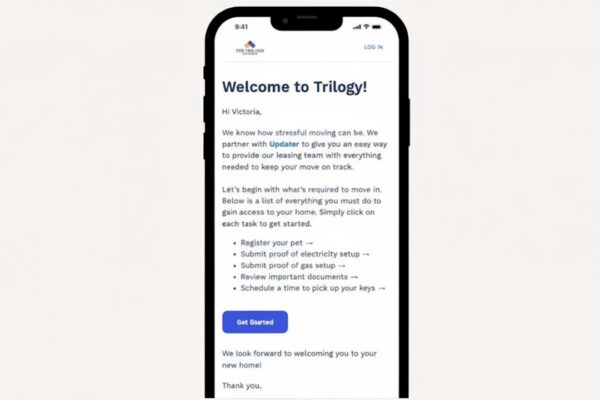
When residents instantly recognize that the message applies to them and their move, engagement goes up. That’s one reason welcome letter emails sent through Updater see a 90% open rate and a +75% claim rate.
Clarity builds trust. And trust drives action.
2. Give residents a clear place to start
Residents don’t need to know everything on day one. They need to know what to do next.
Even when there are multiple required tasks, the first message should create orientation. It should answer:
- Where do I begin?
- What matters right now?
- Where can I reference the full list later?
Welcome emails perform best when they:
- Provide a clear starting point
- Organize required tasks in a way that feels manageable
- Avoid overwhelming residents with unnecessary context
In our experience, clarity early on reduces inbound questions, last-minute scrambles, and missed tasks. When residents feel oriented, everything downstream runs more smoothly.
Think of the welcome email as a map, not a manual.
3. Match the message to the moment
A great message sent at the wrong moment is still easy to ignore.
While subject lines and copy matter, timing often determines whether a resident actually takes action.
In our experience, welcome emails perform best when they are:
- Sent close to a meaningful moment in the resident’s journey (like immediately after sign-up or lease execution)
- Aligned to the resident’s actual move-in timeline
- Followed by reminders based on a mix of timing and behavior, not a static schedule
We’ve found that engagement increases when communication maintains momentum. When a resident has taken a step, that’s often the best time to guide the next one.
Broad trends also matter. For example, weekend sends tend to see lower engagement, reinforcing the importance of being intentional about when messages land.
Small timing adjustments can meaningfully improve follow-through.
4. Relevance builds trust
Residents are quick to tune out communication that feels generic or unnecessary.
The most effective welcome emails are tightly connected to what the resident actually needs to do. Every message should have a clear purpose.
In our experience, welcome emails perform best when they:
- Focus only on required or high-priority move-in tasks
- Avoid promotional language or unrelated updates
- Clearly connect the message to an immediate action
When residents understand why they’re receiving a message and what it’s asking them to do, trust builds naturally.
Over time, we’ve seen that relevant, action-oriented communication drives higher task completion and reduces the need for manual follow-up. When every message earns its place, residents stay engaged, and onsite teams spend less time chasing tasks.
5. Test, listen, improve, repeat
One of the biggest lessons we’ve learned is that resident communication is never “done.”
We continuously review performance and listen to partner feedback to refine our approach. Sometimes that means:
- Adjusting message volume
- Rewording subject lines
- Removing emails that aren’t adding value
We pay close attention to how residents engage and regularly refine message volume so communication feels helpful, not overwhelming. That means consolidating, adjusting, or removing messages that don’t earn their place.
What this means for your community
A strong welcome email doesn’t need to be long or overly polished. It needs to be clear, easy to understand, and easy to act on.
When residents know exactly what’s expected and where to go next, they’re more likely to complete required tasks on time and with confidence. That clarity reduces last-minute scrambling and inbound questions for onsite teams.
When communication is relevant, organized, and timely, residents naturally feel supported.
That’s the goal of every message we send.
If you’re curious how this looks in practice, you can hear directly from residents and onsite teams about their experience with Updater.